
Why Kingston Flemings Could Be the Top Point Guard in the 2026 NBA Draft

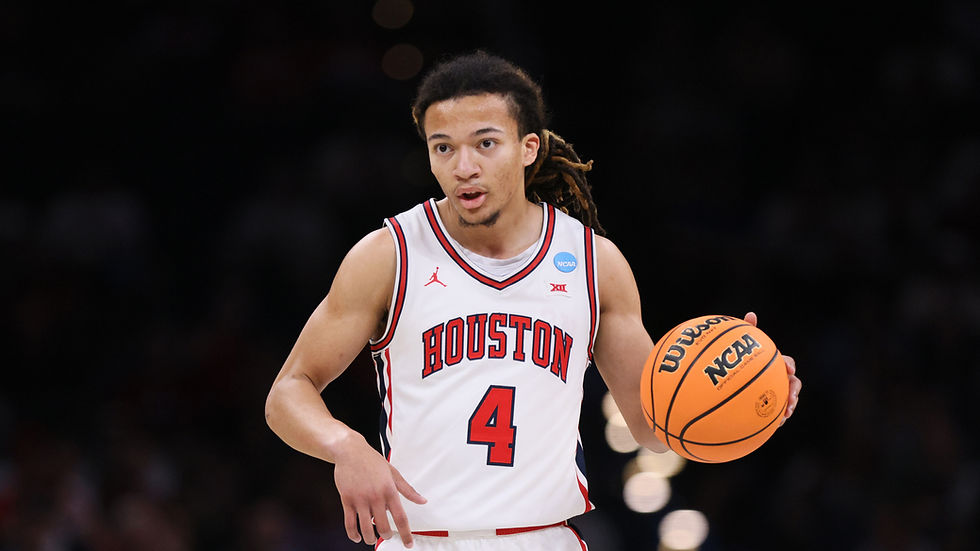
Kingston Flemings may not look like the cleanest modern point guard prospect on the surface, but his statistical profile, feel, touch, and Houston context create one of the more compelling upside bets in the 2026 NBA Draft. The question is whether his shot diet at Houston reflects who he is or hides what he could become in a more NBA-style offense.
Historical Context for Guards
Kingston Flemings is a prospect who breaks the line between “old basketball” and “new basketball.” The former is the midrange-heavy, slower-paced guard archetype, which is how he was cast during his lone season at Houston under Kelvin Sampson. The latter is a high-feel and high-touch ballhandler who sets the structure of an offense through a combination of scoring gravity and playmaking.
In the NBA that unfolded after the removal of the illegal defense rule, these kinds of midrange-heavy guards often failed to reach the promised land without outlier turnover suppression baked into their profiles through pull-up excellence. The late Kobe Bryant was the only player to fit this mold and make a Finals appearance as his team’s best player.
In the modern NBA, post-Seven Seconds or Less Suns, Moreyball Rockets, and, most importantly, the Warriors dynasty, multiple guards have made Finals appearances while fitting this broader archetype. Stephen Curry, Tyrese Haliburton, Shai Gilgeous-Alexander, Chris Paul, and whatever position you classify Luka Doncic as playing make up the list of guards to lead their year in Dunks and Threes Estimated Plus-Minus all-in-one metric while making the Finals.
That broader mold is where Flemings becomes so interesting. In fact, Gilgeous-Alexander and Paul’s primary form of pressuring the defense is through high midrange shot volume. Notably, though, Flemings shares more common analytical traits with Curry and Haliburton than the rest of the group.
Among guards since 2008, Flemings sits alongside Curry and Haliburton as the only players to ever put up 80% or better from the free-throw line, a 12% or better defensive rebounding percentage, a 30% or better assist percentage, a steal percentage above 3%, and a defensive box plus-minus above 3 in an age-22-or-under season.
While Barttorvik’s college basketball database does not include Paul’s Wake Forest years, and NCAA rate stats from that period are limited, his long-term NBA profile suggests he would fit the same analytical profile.
Feel as a Skill
Like Curry, Haliburton, and Paul, Flemings is among the highest-feel guards of his generation, and he accomplished these analytical feats while being the youngest on draft day among the players in this comparison group.
While steals are not the end-all, be-all of defense, at the guard position in particular, they can be more of a feel indicator than many other defensive marks. Steals can indicate rotational awareness, quality hands, and timing, all traits that players with other feel indicators in their film and analytics tend to possess.
Watching Flemings play, it is easy to see his defensive feel. He frequently executed Houston’s complex scheme at a high level, finding X-outs, tagging rollers, and serving well at the point of attack. This nose for the ball and the right spot extends throughout his high school and AAU profiles, which, while limited and noisy, give confidence that he was not simply bolstered by Sampson’s heavy turnover-generation scheme. Instead, he fit the scheme because of prior excellence. Per DraftExpress Gold and MaxPreps, Flemings posted a 3.4% steal rate in his Puma PRO16 sample and averaged 2.9 steals per game as a high school senior.

As a passer, he possesses the best overall passing numbers and film among this year’s freshman draft class. He has a knack for extending his advantage to the max, frequently keeping his dribble alive for last-second kickouts to open shooters or quick live-dribble passes to cutters for easy looks at the rim. He is never out of control inside the lane and has an understanding of risk-reward that few 19-year-old guards possess.
Houston’s offense looked different with him on the floor this past season. The Cougars went from an above-average team in offensive turnover rate to one of the best the NCAA has ever seen. Flemings’ presence moved Houston to an obscene 12.3% offensive turnover rate against top-200 teams, which would be the best mark for a high-major team in Barttorvik’s college basketball database, dating back to 2008. He suppressed turnovers while not being pass-avoidant in the way a pull-up two-guard might be. Houston’s overall rim frequency rose with Flemings on the floor, as did its assisted rates at the rim, which speaks to his creation for others.
The Scoring Efficiency Question
The biggest question with Flemings is whether his shot diet can translate cleanly to the NBA. His game at Houston leaned heavily on midrange shots, and he had not yet shown the pull-up three-point volume or rim pressure needed to project as an obvious high-efficiency scorer. On the surface, that complicates his offensive projection.
The place I think many scouts could be overlooking with Flemings is that Houston may be one of the most difficult offensive environments for a guard, which actually bodes well for his projection.

The part of Kingston’s profile I have tended to neglect up until this point is how absurdly good his touch is. After shooting below 70% from the line in his first two high school seasons, he jumped to 80% from the stripe in his junior and senior seasons across nearly 300 total attempts. In his AAU sample, he shot 87% from the line, and this year at Houston, he improved his overall free-throw percentage to 84.5%. It is rare for players to improve their free-throw percentage from their high school sample to their NCAA sample, but this is another indication of Flemings continuing to grow his already excellent touch.
His 46% mark on two-point dribble jumpers this year is another indicator of high-level touch. Flemings was also only 61% assisted on his three-point makes, a lower number than both Darius Acuff and Brayden Burries. Mechanically, his shot can look out of place, but people said the same thing about his analytical brethren, Tyrese Haliburton, during his pre-draft season. Touch indicators tend to trump mechanics.
There is enough skill here for Flemings to reliably get to his pull-up from two. There is no functional reason he cannot do it from three. He played in an offensive context that drove midrange shots, and he is still new to shooting threes at volume. In fact, he shot the most threes of his career as a freshman in high school, with a 42% three-point rate. This was before he could blow by everyone for easy rim shots in high school. As he scales to better defenders in the NBA, why wouldn’t Flemings revert to shooting more threes as a scoring option?
If his profile indicates more three-point juice than he showed at Houston, then what about his two-point issues? This is where the Kelvin Sampson question comes in.
There’s no denying Sampson is an incredible coach. He is a first-ballot Hall of Famer who brought Houston back to national relevance and is one of the most respected figures in the game, deservedly so. But he has essentially gamified accepting difficult shots as a rebounding and turnover-suppression tactic in order to win the possession battle. This leads to an offensive environment with a crowded paint, limited spacing, and a structure in which guards often have to take pull-ups en masse to score. It creates a cycle in which Houston can offset shot quality by generating more possessions than its opponent.
Within that unconventional offensive system, Flemings actually wildly outperforms Sampson’s history of guards. No Houston guard has gotten to the rim at the rate Flemings did. He took more shots at the rim than any guard has since Sampson took over, despite a lower overall usage rate than many guards during the Cougars’ time in the American.
Nobody has excelled as a two-point scorer in this offense at Flemings’ efficiency rate, and that aligns with his grassroots priors being far better than his NCAA two-point numbers. In his PRO16 sample, Flemings shot 57% from two on 11 shots per game, while also posting a .62 free-throw rate, something else Sampson’s offense tends to remove from its guards. As a high school senior, he shot a remarkable 74% from two and still posted a better free-throw rate than he did at Houston, which, considering the ease with which he got to the rim, may be even more impressive.
The context Kingston found himself in this year was one where he needed to play the way he did to succeed. With the right developmental situation and the right people around him, there is a clear pathway to much higher outcomes. Urging Flemings to shoot more dribble threes, placing him in an offense that creates more catch-and-shoot chances, and still using him as the primary driver of offense through his downhill ability and playmaking could unlock something significant.
The truth is, fast-forward 10 years, and I would not be surprised if Flemings ended up as the best player from this class. He is a scheme-agnostic lead playmaker who has dominated everywhere he has been. Flemings can fit in an offense built around offensive rebounding, as he showed at Houston, but he also has the burst to excel in a half-court, ball-screen-based offense. He is also among the best transition scorers in this class. It felt like every time the normally plodding Houston offense had a chance in transition, Flemings was the one leading the charge.
The Pitch
Flemings possesses a rare combination of touch, skill, and feel, and that is why he is my clear PG1 for this year’s draft class. On the surface, he may seem restrictive as a scorer, making it harder for him to achieve high-end outcomes. But high feel, touch, and defensive playmaking intersections tend to trump all when it comes to NBA star guards. If you go down the list of the best offensive handlers in league history, nearly every single one of them is positive relative to position in touch and feel. Kingston is, too, and he can also get it done defensively.
Everything Flemings does is methodical, but his brain does not work slowly. He processes the game at a breakneck speed. His ability to process the floor is what makes him, and most NBA star guards, who they are. Flemings’ touch projection then puts him far ahead of other “process only” draft prospects at guard, as the potential for a nuclear scorer is there. It just has to be understood and weaponized.
The traits of a transformational player come through in Flemings’ game more clearly than they do with any other guard in this class. It may be some time before another prospect of his mold is seen again.


